The Grid Method for Drawing
Learn the time-tested grid method for scaling and transferring artwork with perfect proportions. A complete guide with a free interactive tool.
What Is the Grid Method?
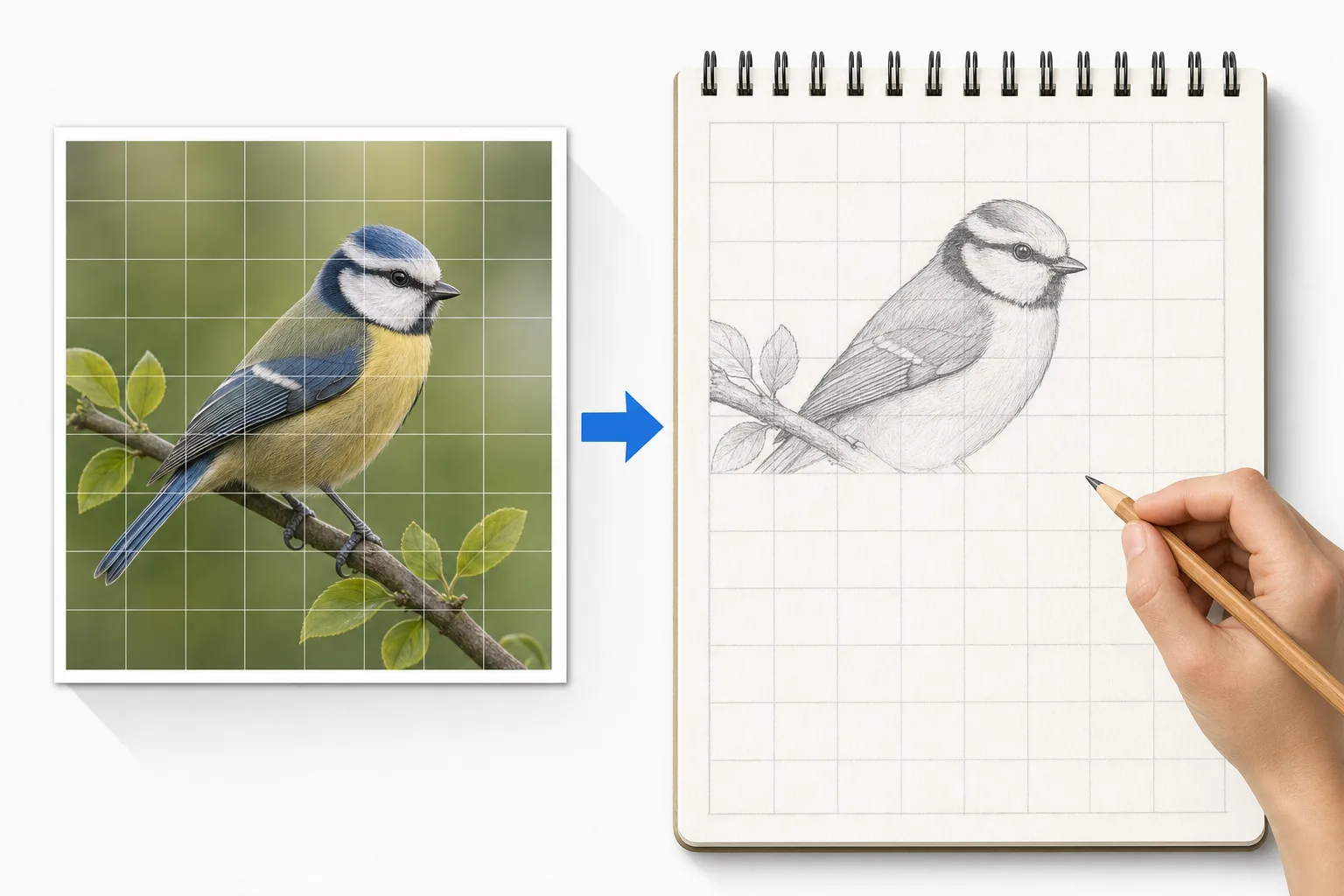
The grid method (also called the grid drawing technique) is one of the oldest and most reliable ways to reproduce or scale a reference image. You overlay a grid of equal-sized squares on your reference, draw a matching grid on your paper or canvas - at whatever scale you need - and copy the contents of each square one at a time.
Because you only focus on one small section at a time, even complex subjects become manageable. The method trains your eye to see shapes, values, and spatial relationships more accurately - skills that eventually carry over into freehand drawing.
A Brief History of the Grid Method
Artists have used grids for centuries. In the 15th century, Leon Battista Alberti described a veil of threads (a physical grid) stretched across a frame as a drawing aid. Albrecht Dürer famously documented grid devices in his woodcuts. The Renaissance masters used grid-like methods to transfer preparatory sketches to full-scale walls for frescoes.
In the 20th century, photorealist painter Chuck Close became synonymous with the grid method, creating monumental portraits built square by square. Today, the technique remains a staple of art education worldwide.
Step-by-Step: How to Use the Grid Method
- Prepare your reference. Upload your reference image to our grid overlay tool and choose a grid size (8×8 is a great starting point). Download or print the gridded reference.
- Draw a grid on your surface. Using a ruler and light pencil lines, draw the same number of rows and columns on your paper or canvas - scaled to your desired output size.
- Transfer square by square. Working one section at a time, draw the shapes and contours you see in each reference square into the corresponding square on your surface.
- Refine and erase. Once all sections are transferred, gently erase the grid lines. Refine contours, add shading, and complete your artwork.
Tips for Mastering the Grid Method
Label your grids. Number the rows and columns on both the reference and your drawing surface so you never lose track of which square you're working on. Our drawing grid tool adds labels automatically.
Use a contrasting line color for the reference grid - red or blue lines stand out against most photographs. On your drawing surface, use the lightest possible pencil lines that you can still see, to make erasing easier later.
Start with large shapes in each square, then add progressively smaller details. Ensure that lines crossing square boundaries align properly with neighboring squares for a seamless result.
Key Features
Step-by-Step Guide
Follow our detailed tutorial to master the grid method from beginner to advanced.
Interactive Grid Tool
Apply the grid method instantly with our free online grid overlay tool.
Scale Any Artwork
Enlarge or reduce artwork while keeping every proportion perfectly intact.
Works on Any Medium
Use the grid method with pencil, charcoal, paint, or digital art.
Historical Technique
Learn a method used by master artists for over 500 years.
Free & Accessible
No signup or payment needed. Start learning and practicing immediately.
Frequently Asked Questions
- What is the grid method in art?
- The grid method is a drawing technique where you overlay a grid on a reference image and draw a proportional grid on your drawing surface. By copying the contents of each grid square one at a time, you achieve accurate proportions and placement, even when changing the scale of the artwork.
- Is the grid method good for beginners?
- Yes, the grid method is one of the best techniques for beginners. It breaks a complex image into small, manageable sections, builds observation skills, and teaches proportional accuracy. Many art instructors use it as a foundational exercise.
- Is the grid method cheating?
- No. The grid method is a legitimate and time-honored artistic technique used by professionals and masters throughout history, including Albrecht Dürer and Chuck Close. It teaches observation skills and is widely used in art education.
- How do I choose the right grid size?
- The right grid size depends on the complexity of your subject and your skill level. A 4×4 grid works for simple compositions. An 8×8 or 10×10 grid is ideal for most subjects. For highly detailed work, go up to 16×16 or beyond.
- Can I use the grid method to enlarge a small photo?
- Absolutely. Draw a small grid on (or over) your reference photo, then draw a proportionally larger grid on your canvas. Copy each section to the larger square, and the final drawing will be an accurate enlargement.
- What tools do I need for the grid method?
- You need a reference image, a ruler (or our digital grid tool), a pencil for sketching the grid on your drawing surface, and an eraser for removing grid lines afterward. Our online tool handles the reference grid digitally so you only need to draw the canvas grid by hand.
Specialist tools for bigger projects
All Pro tools →Poster Splitter
Print a large image on multiple pages at its real size - with a drawing grid that continues across every sheet.
Mural Scaling Calculator
Scale a reference to wall size with chalk-line positions and paint estimates.
Perspective Grid Generator
1, 2 and 3-point perspective grids with downloadable overlays.
Art Projector
Trace references on your tablet screen with a grid overlay.
Free previews on every tool · full output with Pro (free trial)
Explore More Grid Tools
Grid Overlay Tool →
Overlay a grid on any reference image instantly.
Drawing Grid Tool →
Create precise drawing grids for proportional transfer.
Grid Generator →
Generate custom blank grids for any project.
Printable Grid Paper →
Print grid paper in custom sizes.
Grid Drawing App →
All-in-one browser grid drawing application.
Photo Grid Maker →
Arrange multiple photos into grid collages.
Start Creating Perfect Grids Today
100% free, no signup required. Join thousands of artists using our professional grid drawing tools.
Open Grid Maker